What Is a Turbine Meter? A Complete Guide for Professionals
In industrial flow measurement, precision and reliability are essential. One of the most reliable instruments for liquid and gas measurement is the turbine-type flow meter, known for its accuracy and repeatability. But how does this device actually work, and where is it most effective?
This guide explores the working principle, benefits, and industrial applications of this measurement technology.
What Is a Turbine Flow Meter?

A turbine meter is a mechanical flow instrument that measures the volumetric flow rate of liquids or gases. It operates on a simple yet highly precise principle: when the process medium passes through the housing, it rotates a multi-blade turbine wheel positioned in the flow path.
The rotational speed of this wheel is directly proportional to the velocity of the fluid, allowing the device to calculate total flow with exceptional accuracy.
Used in sectors such as oil and gas, water treatment, and chemical processing, turbine-type meters are trusted for their reliability, repeatability, and fast response time in both low and high flow applications.
How Does a Turbine Flow Meter Work?
To understand how a turbine flow meter works, imagine a fluid or gas moving through a specially designed body containing a multi-blade rotor. As the medium passes through, it strikes the blades, causing the turbine to rotate at a speed proportional to the flow rate.
A magnetic or optical pickup sensor detects each rotation and converts it into an electrical pulse signal. This signal is then processed by a transmitter or flow computer, which calculates both instantaneous flow and total volume.
Because the turbine’s rotational speed has a linear relationship to the fluid velocity, this measuring technology ensures high accuracy, quick response, and excellent repeatability — even under varying temperature or pressure conditions.
Types of Turbine Flow Meters
Turbine technology comes in several designs to suit different media and operating conditions. Each variant offers unique advantages depending on the viscosity, temperature, and cleanliness of the fluid being measured.
Liquid Models
These instruments are designed for clean, low-viscosity liquids such as water, fuels, and light oils. They are widely used in hydraulic systems, process lines, and fuel monitoring applications where accuracy and repeatability are essential.
Gas Models
Built for natural gas, compressed air, and other non-corrosive gases, these models feature lightweight rotors and specialised bearings. They deliver reliable performance even at high flow velocities and low pressures, making them ideal for energy and industrial gas systems.
Sanitary Models
Manufactured from stainless steel and compliant with hygienic standards, these versions are used in food, beverage, and pharmaceutical production. Their smooth internal surfaces support CIP (Clean-in-Place) procedures and ensure product safety without contamination.
Advantages of Turbine Flow MetersTurbine-based flow measurement remains a preferred choice for industrial applications thanks to its precision, speed, and reliability. These instruments combine proven mechanical design with modern electronic signal processing, delivering excellent performance across a wide range of process conditions.
Main benefits include:
- High accuracy: typically within ±0.5% of the measured value.
- Wide measurement range: effective in both low and high flow rates.
- Fast response: provides real-time flow feedback for process control.
- Excellent repeatability: ensures consistent readings under stable conditions.
- Simple maintenance: minimal moving parts and easy calibration.
- Digital compatibility: available with pulse, 4–20 mA, or Modbus outputs.
- Cost efficiency: delivers high precision at a lower price than many alternative technologies.
When correctly installed and maintained, turbine flow meters offer long-term durability and dependable performance, making them a smart investment for process engineers and plant operators.
Applications of Turbine Flow Meters
Turbine meters are widely used across:
- Oil & Gas: Custody transfer, fuel measurement, refining.
- Water & Wastewater: Network distribution and treatment control.
- Chemical Industry: Monitoring solvent and additive flows.
- HVAC & Energy: Cooling water and thermal energy systems.
- Aerospace & Automotive: Engine testing and fuel monitoring.
They also support hydrology and environmental systems, providing accurate water usage data for sustainable management.
Choosing the Right Turbine Flow Meter
Before purchasing, consider:
- Fluid type and viscosity
- Flow range and operating pressure
- Temperature limits
- Installation orientation
- Output signal (pulse, 4–20 mA, Modbus)
At Dimens, we offer a complete range of Turbine Flow Meters. designed for industrial environments.
For professionals seeking maximum reliability, explore our featured model — the Trigas Turbine Flow Meter — combining proven turbine technology with advanced electronics.
Learn more about flow measurement technologies at RST Elektronik
Conclusion
A turbine flow meter remains one of the most reliable and efficient instruments for accurate flow measurement in industrial applications. When properly installed, it ensures long-term precision, data consistency, and process efficiency.
For professional advice and product selection, contact Dimens — your trusted partner for industrial flow and level measurement solutions.
FAQ: Turbine Flow Meters
How does a turbine meter work?
A turbine meter measures volumetric flow by using a multi-blade rotor that spins as fluid passes through the metering chamber. A magnetic or optical pickup counts blade passes and outputs pulses proportional to flow rate. This linear relationship enables precise totalising and realtime flow indication.
What fluids are suitable for a turbine flow meter?
Turbine meters perform best with clean, low-viscosity liquids (e.g., water, diesel, light oils) and conditioned gases (natural gas, compressed air). Suspended solids, entrained gas in liquids, or very high viscosity can reduce accuracy and shorten bearing life. If in doubt, review viscosity, filtration, and installation conditions or consider an alternative technology.
How accurate is a turbine flow meter?
Typical accuracy is ±0.5% of reading with good upstream/downstream straight-run, proper sizing, and clean media. Repeatability is often better than accuracy (e.g., ±0.1%). For high-integrity applications, periodic calibration and correct signal conditioning are essential.
What is the difference between a turbine flow meter and an electromagnetic flow meter?
A turbine meter is mechanical and needs conductive media only for electronics power/signal, not for the measurement itself; it excels with clean, low-viscosity liquids and offers fast response. An electromagnetic meter (magmeter) is non-intrusive with no moving parts, requires conductive liquids, tolerates some solids, and typically offers stable accuracy across a wide turndown. Selection depends on media, conductivity, solids content, turndown, and maintenance expectations.
Where can I find a turbine flow meter for industrial use?
Dimens offers a complete portfolio of turbine solutions. See the category page at Flow Meter Types and review our product page: Trigas Turbine Flow Meter.
In this article
Related products

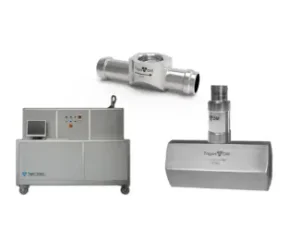 ProductTrigas Turbine Flow Meter: Precision RedefinedView product →